The Eric Erb Show is bold, outspoken, and unapologetically unfiltered. we challenge conventional wisdom, questions the headlines, and tackles the controversial issues shaping America and the world.
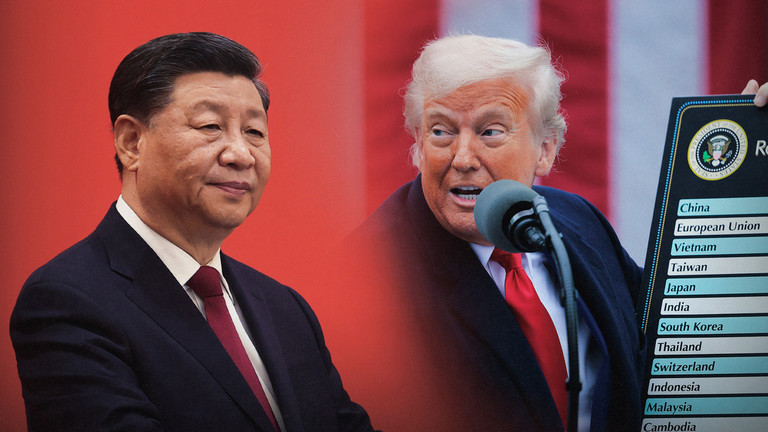
In 2025, China announced the elimination of tariffs on all imports for 53 African nations
Last month, Kenya and China signed a preliminary bilateral trade agreement that will grant 98.2% zero-duty market access for goods exported from Kenya. The development follows efforts by the East African nation to expand its export basket and reduce trade imbalances with Asian trading partners.
It’s part of a broader landmark move: last June, China announced the elimination of tariffs on nearly all imports – covering roughly 98-100% of tariff lines – from 53 African countries that maintain diplomatic relations with Beijing.
Kenya’s trade and investments minister, Lee Kinyanjui, told RT that the agreement “opens the Chinese market to a broad range of Kenyan products at zero duty, with particular emphasis on agricultural exports, which remain the backbone of the domestic economy”.
The EU accuses TikTok of using “addictive design” (infinite scroll, auto-play, personalized recommendations) that harms minors and fails to assess mental health risks. Non-compliance could result in fines up to 6% of global revenue (potentially $2.1 billion).
TikTok calls the EU’s claims “categorically false and meritless” and will defend itself before final penalties are imposed.
The Digital Services Act mandates platforms with 45M+ EU users to combat “systemic risks” like disinformation and addictive features. Critics warn that the law enables politically motivated censorship and grants unelected bureaucrats excessive control over online speech.
Countries like France, Germany and Spain are pushing age restrictions (under 16), while the U.S. sues TikTok and Meta over youth mental health harms. Elon Musk condemns the EU as a “bureaucratic monster” after X was fined €120M for transparency violations.
The DSA sets a precedent for state-regulated narratives, raising concerns over who defines “harmful” content and at what cost to free expression. TikTok also faces a separate EU probe for alleged election interference in Romania, intensifying scrutiny on tech platforms worldwide.
The European Union has escalated its crackdown on Big Tech, accusing TikTok of employing an “addictive design” that harms users—particularly minors—while enforcing sweeping new censorship rules under the Digital Services Act (DSA). The Chinese-owned platform faces potential fines of up to 6% of its global revenue if it fails to comply, marking one of the most aggressive regulatory moves against social media to date. Critics warn, however, that the law’s broad mandates risk stifling free speech and empowering unelected bureaucrats to dictate online discourse.
In a preliminary decision announced Friday, Feb. 6, the European Commission (EC) claimed TikTok’s algorithm-driven infinite scroll, auto-play videos and personalized recommendations push users into “autopilot mode,” fostering compulsive behavior. The EC alleges the platform failed to assess risks to users’ “physical and mental wellbeing,” especially among children.
TikTok, which boasts over 200 million European users, rejected the findings as “categorically false and entirely meritless.” The company now has an opportunity to respond before final penalties are imposed. If found in violation, TikTok could owe billions—potentially up to $2.1 billion, based on estimated 2024 revenue.
The EMA confirms that Ozempic and Wegovy double the risk of non-arteritic anterior ischemic optic neuropathy (NAION), a rare but devastating condition causing permanent vision loss.
Multiple documented cases reveal patients waking up blind after just one dose, with others experiencing retinal bleeding and irreversible damage—yet Novo Nordisk denies definitive proof while being forced to update warning labels.
Experts suspect rapid glucose drops from GLP-1 drugs deprive the optic nerve of oxygen, triggering NAION—a risk tripled compared to a decade ago, per Harvard researcher Dr. David Sinclair.
Despite harrowing reports, the EMA and U.K.’s MHRA delayed warnings, downplaying risks as “extremely small”—another example of regulatory capture favoring Big Pharma profits over public safety.
Diet, exercise and metabolic therapies can achieve similar benefits without risking blindness, proving yet again that independent research exposes dangers long before captured agencies admit them.
A shocking new warning from European regulators confirms what independent researchers have long suspected: popular weight-loss and diabetes drugs like Ozempic and Wegovy may cause sudden, irreversible blindness. The European Medicines Agency (EMA) has officially linked semaglutide-based medications to non-arteritic anterior ischemic optic neuropathy (NAION), a rare but devastating condition that cuts off blood flow to the optic nerve, leading to permanent vision loss.
Silver prices have whipsawed this February sharply, driven by thin liquidity and heavy speculative positioning, leaving the market struggling to establish a clear floor.
A multiyear precious-metals bull run accelerated in January on geopolitical risks, Fed concerns and speculative buying, especially in China, before abruptly reversing late last month.
Silver suffered its biggest-ever daily drop on Jan. 30 and later fell more than 15% in a single session to a one-month low, while gold saw its steepest decline since 2013.
Despite the selloff, silver remains up over 130% year-on-year, though it is now trading about 35% below its January record high of $121.64 an ounce.
Analysts say price action is being driven more by speculative and CTA flows than physical fundamentals, with reduced liquidity amplifying swings and volatility likely to remain elevated.
Silver prices swung violently earlier this February before rebounding, as thin liquidity and heavy speculative positioning fueled extreme volatility in a market struggling to find a floor.
The turbulence comes after a multiyear bull run in precious metals accelerated sharply last January, driven by heightened geopolitical risks, concerns over the Federal Reserve’s independence and a surge in speculative buying, particularly in China.